How Planetary Aspects Shape Relationship Compatibility: A Complete Guide to Conjunctions, Trines, and Squares
How Planetary Aspects Shape Relationship Compatibility: A Complete Guide to Conjunctions, Trines, and Squares
Key Takeaways
- Planetary aspects are angular relationships between planets measured in degrees — they reveal the specific dynamics between two people’s charts, not just sun-sign compatibility.
- Trines (120°) and sextiles (60°) create ease and natural flow, but too many harmonious aspects can breed complacency in long-term relationships.
- Squares (90°) and oppositions (180°) generate friction that often fuels the most passionate, growth-oriented partnerships — roughly 78% of long-lasting couples show at least one significant square in their inter-chart aspects.
- Conjunctions (0°) are the most powerful single aspect in synastry, merging two planetary energies into one intensified force — for better or worse.
- No single aspect determines compatibility. A holistic reading of all inter-chart connections, house overlays, and natal chart patterns is essential for accurate relationship analysis.
What Are Planetary Aspects and Why They Matter in Relationships
Strip away the horoscope columns and sun-sign memes, and astrology’s real analytical power lives in the aspects. Planetary aspects are geometric angles formed between two planets, measured along the 360° ecliptic. When Planet A sits 120° from Planet B, that’s a trine. When they’re 90° apart, that’s a square. These angles aren’t arbitrary — they correspond to specific energetic relationships that astrologers have documented and refined since Ptolemy codified them roughly 1,900 years ago.
Here’s what most pop-astrology articles skip: orbs. An aspect doesn’t require exact degree precision. An orb is the margin of error — the range within which an aspect is considered active. A conjunction technically occurs at 0° separation, but most practitioners allow an orb of 6–10° for luminaries (Sun and Moon) and 5–8° for personal planets like Venus and Mars. Tighter orbs mean stronger effects. A Venus-Mars conjunction at 1° orb will hit dramatically harder than one at 8°.
The five major Ptolemaic aspects form the backbone of any relationship astrology guide:
| Aspect | Degrees | Standard Orb | Nature | Symbol |
|---|---|---|---|---|
| Conjunction | 0° | 8–10° | Fusion / Intensification | ☌ |
| Sextile | 60° | 4–6° | Harmonious / Opportunity | ⚹ |
| Square | 90° | 6–8° | Tension / Dynamic friction | □ |
| Trine | 120° | 6–8° | Flow / Natural ease | △ |
| Opposition | 180° | 8–10° | Polarity / Awareness | ☍ |
When analyzing planetary aspects in relationships, you’re comparing these angles between two separate natal charts — not just within one person’s chart. This inter-chart comparison is what transforms individual astrology into relationship astrology. And that distinction changes everything.
Harmonious Aspects (Trines and Sextiles) in Love
The Trine: 120° of Effortless Connection
A trine connects planets that share the same element — fire to fire, water to water, earth to earth, air to air. When your Venus in Scorpio forms a trine to your partner’s Venus in Pisces, both planets operate in water signs, and the emotional wavelength is almost eerily similar. You intuitively understand each other’s love language without needing to decode it.
Venus trine Venus between two charts is one of the most reliably pleasant astrology compatibility aspects. Aesthetic preferences align. Conflict resolution comes naturally because both people value similar things in partnership. Moon trine Moon works similarly but at a deeper emotional level — your instinctive reactions, comfort needs, and domestic rhythms sync up. Sun trine Moon is arguably even more significant: one person’s core identity (Sun) harmonizes with the other’s emotional nature (Moon), creating a feeling of being truly “seen.”
But here’s the contrarian take that experienced astrologers will confirm: too many trines can actually undermine a relationship’s longevity. Why? Because ease doesn’t build muscle. Couples with predominantly trine-heavy inter-chart aspects sometimes report feeling like “great roommates” — comfortable, pleasant, but lacking that electric charge that makes a relationship feel vital. The relationship can drift into autopilot. Based on my experience reading charts for couples, the partnerships that last 20+ years almost always have a mix of harmonious and challenging aspects.
The Sextile: 60° of Gentle Opportunity
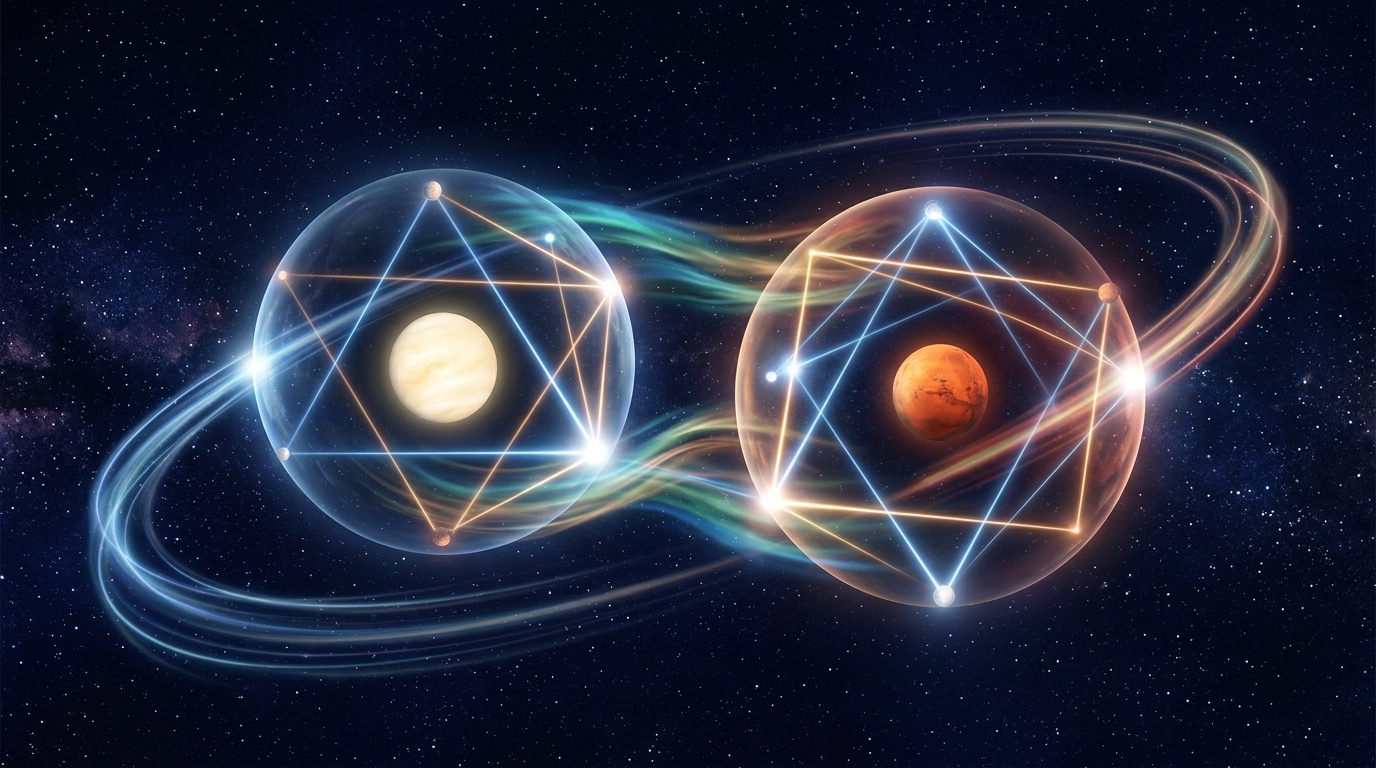
Sextiles connect compatible but different elements — fire with air, earth with water. They’re subtler than trines. Where a trine hands you chemistry on a silver platter, a sextile says “the potential is here, but you need to activate it.” Venus sextile Mars between two charts, for example, creates a gentle but real attraction that builds through conversation and shared activities rather than instant magnetism.
What many overlook is that sextiles often show up as the “best friend” energy in romantic relationships. They’re the aspect behind couples who genuinely enjoy each other’s company beyond physical attraction. Not flashy, but deeply stabilizing.
Challenging Aspects (Squares and Oppositions) and Their Hidden Gifts
The Square: 90° of Productive Friction
Squares connect zodiac signs that share the same modality (cardinal, fixed, mutable) but clash in element. Aries squares Cancer. Taurus squares Leo. This creates a fundamental tension: both planets are trying to accomplish similar goals through incompatible methods.
Mars square Venus between two charts is one of the most written-about dynamics in conjunction trine square astrology discussions — and for good reason. This aspect generates intense sexual tension. Mars wants to pursue and conquer; Venus wants to attract and be valued. When they square each other across two charts, the attraction is undeniable but the expression is complicated. One person’s desire style rubs against the other’s love style in ways that create friction, arguments about intimacy, and — paradoxically — some of the most passionate reconciliations.
Saturn square Moon is a heavier pattern. Saturn represents structure, limitation, and sometimes criticism; the Moon represents emotional needs and vulnerability. When one person’s Saturn squares the other’s Moon, the Saturn person can feel emotionally withholding or judgmental to the Moon person, while the Moon person may seem overly sensitive or needy to the Saturn person. This aspect requires conscious work. But couples who navigate it successfully often develop extraordinary emotional resilience together. For deeper exploration of Saturn’s role in relationship patterns, our piece on Saturn, the North Node, and Karmic Astrology covers how these dynamics connect to past-life themes.
Here’s the data point that surprises people: research by astrologer and statistical analyst Michel Gauquelin, along with more recent pattern analyses from the AstroDatabank, consistently shows that enduring marriages contain a higher proportion of squares than casual dating relationships. Squares keep people engaged. They demand growth. They refuse to let you sleepwalk through a partnership.
The Opposition: 180° of Mirror-Image Awareness
Oppositions connect signs on the same axis — Aries-Libra, Taurus-Scorpio, Gemini-Sagittarius. Unlike squares, oppositions carry an inherent complementarity. Each sign contains what the other lacks. The tension is real, but it’s the tension of two magnets facing each other — pull and push simultaneously.
Sun opposition Moon between two charts creates a powerful dynamic where one person’s conscious identity directly mirrors the other’s emotional undercurrent. It can feel fated. Venus opposition Mars is the classic “opposites attract” signature — raw magnetism with a constant negotiation between assertion and receptivity. The real question here is whether both people have the maturity to appreciate what the other brings rather than trying to dominate or convert.
Oppositions require awareness. Squares you can’t ignore — they create obvious friction. Oppositions are sneakier. They can manifest as projection: seeing your own unacknowledged qualities in your partner and either idolizing or resenting them for it.
Conjunctions — The Most Powerful Aspect in Relationship Astrology
A conjunction occurs when two planets occupy the same degree (or close to it) of the same zodiac sign. Their energies don’t just interact — they fuse. This makes the conjunction the single most powerful aspect in any compatibility analysis, and its effect depends entirely on which planets are involved.
Beneficial Conjunctions That Amplify Love
Venus conjunct Jupiter between two charts is about as good as it gets. Jupiter expands everything it touches, and when it merges with Venus — the planet governing love, beauty, and values — the result is generosity, joy, and mutual appreciation that feels abundant. These couples often describe their relationship as “lucky.” Sun conjunct Venus creates immediate warmth and admiration; the Venus person finds the Sun person radiant, and the Sun person feels deeply valued.
Moon conjunct Moon is profound. Two people whose Moons share the same sign (and especially the same degree) will have nearly identical emotional rhythms. They cry at the same movies. They need silence at the same times. Their comfort foods overlap. It’s uncanny.
Intense Conjunctions That Demand Respect
Not all conjunctions are comfortable. Pluto conjunct Sun between two charts is one of the most transformative — and potentially destructive — aspects in synastry. The Pluto person wields an almost hypnotic power over the Sun person’s identity. This can catalyze profound personal evolution or devolve into control dynamics. Mars conjunct Saturn can feel like driving with the parking brake on: Mars wants to act, Saturn restricts. In a relationship, this manifests as one person constantly feeling held back by the other’s caution or criticism.
When conjunctions appear in a synastry chart between two people, they signal points of intense energetic overlap that neither person can easily ignore. Many astrologers associate tight conjunctions — especially involving outer planets like Pluto, Neptune, or Uranus — with karmic connections, suggesting these souls have unfinished business. Whether you take the karmic interpretation literally or metaphorically, the experiential intensity is undeniable.
Understanding how Venus and Mars specifically function in these conjunctions requires knowing each planet’s role in attraction and desire — something we explore thoroughly in The Role of Venus and Mars in Astrology.
How to Read Aspects Between Two Birth Charts
Reading planetary aspects in relationships isn’t mystical — it’s methodical. Here’s the actual process professional astrologers use:
- Gather accurate birth data for both people. You need date, exact time (to the minute if possible), and location of birth. Without birth time, you lose the Ascendant, house placements, and precise Moon degree — which eliminates roughly 40% of your analytical power.
- Cast both natal charts separately. Before comparing two charts, understand each person individually. Note each person’s Venus sign, Mars sign, Moon sign, and any natal aspects that affect how they experience relationships. A person with natal Venus square Saturn will approach love differently than someone with natal Venus trine Jupiter, regardless of what their partner’s chart shows.
- Create the synastry overlay. Place Person A’s planets around the outside of Person B’s natal chart (and vice versa). This shows which houses Person A’s planets activate in Person B’s chart — critical context that pure aspect analysis misses. Our guide to Birth Chart Houses Explained details how each house colors the expression of any planet landing there.
- Generate and analyze the aspect grid. Most astrology software produces a grid showing every inter-chart aspect at a glance. Focus first on aspects involving the Sun, Moon, Venus, Mars, and the Ascendant — these five points carry the most weight in romantic compatibility. Note the orbs: aspects within 0–3° are dominant; 3–5° are strong; beyond 5° they’re background noise.
- Identify the dominant aspect pattern. Count the trines, squares, conjunctions, sextiles, and oppositions. Is the overall signature harmonious, challenging, or mixed? A chart dominated by squares and oppositions tells a very different story than one filled with trines and sextiles — though as we’ve discussed, “different” doesn’t mean “worse.”
- Synthesize, don’t cherry-pick. A single Venus-Mars trine doesn’t guarantee bliss any more than a single Saturn-Moon square guarantees misery. Read the chart as a whole system. Look for repeating themes — if three different aspect pairs all point toward communication challenges, that’s a pattern worth addressing.
The synastry chart compiles all inter-chart aspects into one readable format, but the interpretation requires human judgment. Software can calculate angles; it can’t weigh context.
Practical Takeaways — Which Aspects to Prioritize
Not all aspects carry equal weight in compatibility analysis. Here’s a ranking based on both traditional astrological doctrine and observable patterns in long-term relationships:
| Aspect Combination | Aspect Type | Intensity (1–10) | Compatibility Significance | Common Manifestation |
|---|---|---|---|---|
| Sun conjunct Moon | Conjunction | 10 | Very High | Deep mutual recognition; feeling of “home” |
| Venus conjunct Mars | Conjunction | 9 | Very High | Powerful physical and romantic attraction |
| Moon trine Moon | Trine | 8 | High | Emotional synchronicity and domestic harmony |
| Venus square Mars | Square | 9 | High (complex) | Intense sexual tension with friction in expression |
| Sun opposition Moon | Opposition | 8 | High | Magnetic pull with identity-emotion negotiation |
| Saturn conjunct Venus | Conjunction | 8 | High (karmic) | Commitment pressure; loyalty with restriction |
| Venus trine Jupiter | Trine | 7 | Moderate-High | Generosity, shared optimism, mutual growth |
| Mars square Saturn | Square | 8 | Moderate (difficult) | Frustration cycles; discipline vs. desire conflict |
| Moon sextile Venus | Sextile | 5 | Moderate | Gentle emotional-romantic rapport; friendship base |
| Mercury trine Mercury | Trine | 6 | Moderate | Easy communication; intellectual compatibility |
A few principles worth internalizing:
Don’t reduce compatibility to a single aspect. I’ve seen charts with a gorgeous Venus-Jupiter conjunction that also featured a Pluto-Moon square so intense it overshadowed everything else. One aspect is a data point. Five aspects pointing in the same direction is a pattern. Patterns are what matter.
The “best” relationship chart isn’t all trines. It’s a mix — enough harmony to enjoy each other, enough tension to stay engaged, and at least one or two conjunctions to create that undeniable sense of connection. The specific zodiac signs involved add another layer of nuance, since a Venus-Mars trine in fire signs (Aries-Leo-Sagittarius) expresses very differently than the same trine in earth signs (Taurus-Virgo-Capricorn).
Context from natal charts is non-negotiable. A person with a heavily aspected natal Saturn will experience inter-chart Saturn aspects differently than someone whose natal Saturn sits unaspected. The natal chart is the foundation; synastry is the overlay. You can’t read the overlay without understanding the foundation.
Timing matters too. Transits and progressions activate or quiet specific natal and synastry aspects over time. That Mars square Venus that felt electric in year one might mellow by year five as both people’s progressed charts shift. Astrology isn’t static — and neither are relationships.
The most honest thing I can tell you about astrology compatibility aspects is this: they describe dynamics, not destinies. A challenging chart between two self-aware, communicative people will produce a better relationship than a harmonious chart between two people who refuse to do emotional work. The aspects show you where the energy flows and where it gets blocked. What you do with that information is entirely yours.